The ROI of Safety: How to Pitch Smart Sensors to Your Board
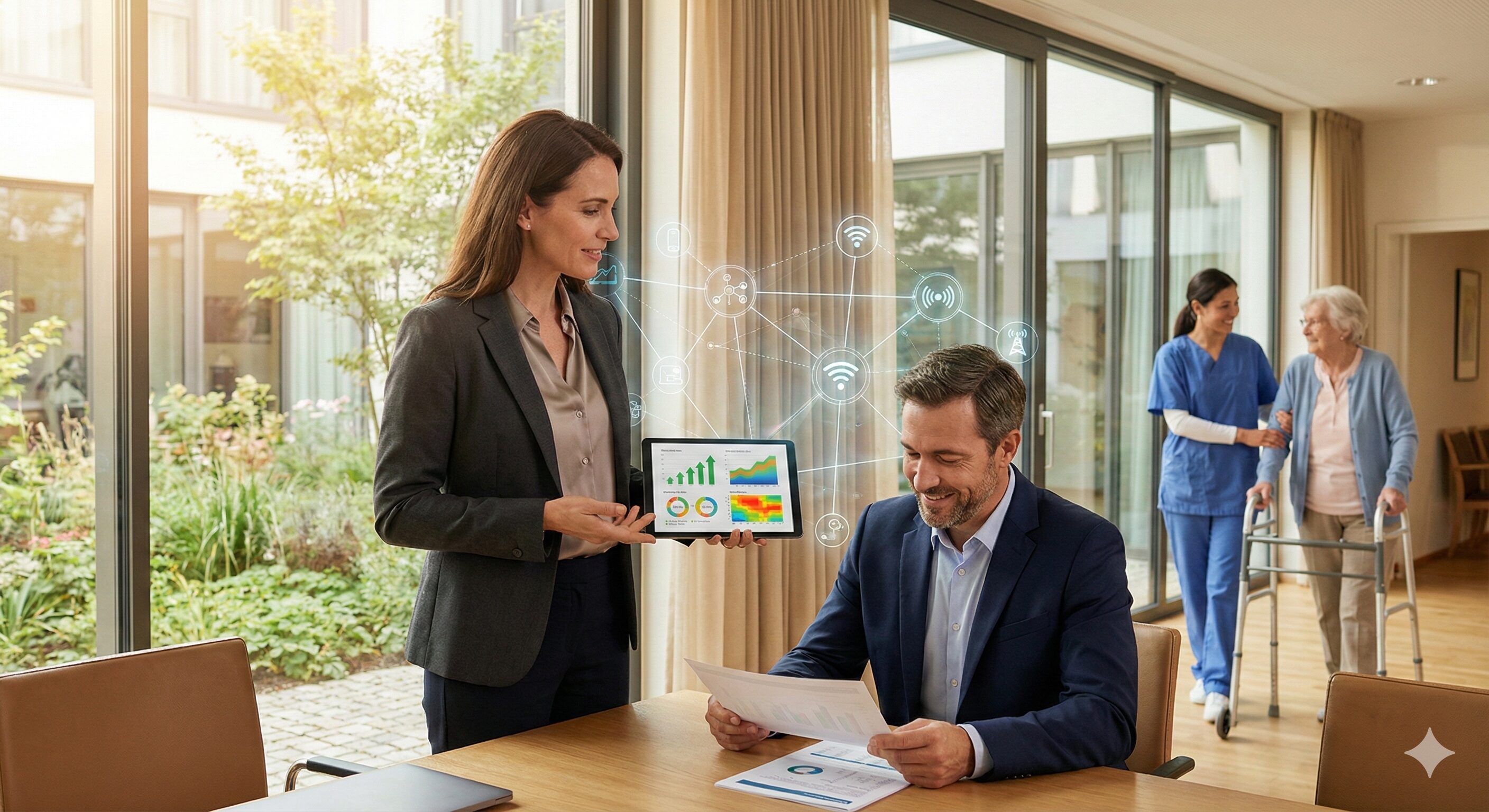
As an Executive Director, you live at the intersection of compassion and commerce. Your daily reality involves balancing the emotional needs of residents and their families with the rigid financial expectations of your investors and board members. You know that investing in advanced care technology, specifically smart sensor systems like Amba, will improve your residents’ quality of life. You see the burnout in your nursing staff’s eyes and know that automated monitoring could alleviate it.
Bridging this communication gap is essential. To secure the budget for the tools your community needs, you must translate clinical outcomes into financial metrics. You need to demonstrate the ROI of senior living technology not just as a “nice-to-have” luxury, but as a critical infrastructure investment that protects the bottom line.
Here is how to build a business case that proves safety is one of the most profitable investments a community can make.
The High Cost of the Status Quo
Before discussing the return on investment, it is crucial to establish the cost of inaction. Traditional monitoring methods are becoming increasingly unsustainable, both operationally and financially.
Consider the standard practice of routine nighttime checks. Staff members physically walk the halls, opening doors every two hours to check on residents. This approach is labor-intensive, disruptive to resident sleep, and prone to human error. It creates a “tick-box” culture in which the goal is to complete the round rather than to provide meaningful care.
From a financial perspective, this is inefficiency at its peak. You are paying skilled caregivers to walk specifically to find out that a resident doesn’t need help.
Smart sensor systems, such as Amba, shift this paradigm from reactive to proactive. By using sleep mats, motion sensors, and door sensors, the system alerts staff only when assistance is required—for example, if “Pat has been out of bed for 20 minutes.” This shift to management-by-exception allows you to reallocate labor hours, reduce overtime, and focus staff energy where it generates value.
Hard Savings: Reducing Operational Waste
When presenting to your board, start with the hard numbers. Operational efficiency is the most direct path to proving ROI.
Labor Optimization
Labor is inevitably your largest expense line item. Smart sensors act as a force multiplier for your existing workforce. Amba’s data indicates that using their system for just 50% of nighttime checks can save up to 15 caregiver hours per week.
Scale that across a month or a year, and the savings become substantial. This doesn’t necessarily mean cutting staff; it means reducing the reliance on agency staff or overtime pay to cover shifts. It means a single night-shift worker can cover a larger area effectively without compromising safety, because they have a digital “glimpse” into every room from their dashboard.
Reducing Fall-Related Costs
Falls are the single greatest liability in senior living. Beyond the devastating physical toll on the resident, a fall triggers a cascade of costs for the operator:
- Increased insurance premiums.
- Potential litigation and settlement costs.
- Operational disruption during incident reporting and emergency response.
Amba’s smart sensor technology has demonstrated an up to 40% reduction in nighttime care costs and falls. By alerting staff the moment a resident creates a high-risk pattern—such as sitting up in bed or opening a door at 3:00 AM—caregivers can intervene before a fall occurs. Presenting a 40% reduction in incident-related costs is a metric any board member will understand immediately.
The Revenue Driver: Occupancy and Length of Stay
While cost savings are important, revenue protection is where the ROI of senior living technology truly shines. The financial health of your community depends on maintaining high occupancy and low resident turnover.
Extending Length of Stay
When a resident experiences a significant health decline or a traumatic fall, they often move out—either to a hospital, a skilled nursing facility, or a competitor offering higher acuity care. This “churn” is expensive. Marketing to, recruiting, and onboarding a new resident costs thousands of dollars in sales commissions and administrative time.
By using ambient technology to monitor sleep quality, activity levels, and continence, you can detect early signs of health changes. This enables preventive interventions that keep residents healthier for longer. Amba has found that their technology contributes to an up to 18-month increase in independent living tenancies.
Do the math for your board: Calculate your average monthly rent. Multiply that by 18. That figure represents the number of smart sensors that can help secure. If the technology helps you retain just three residents for an extra year who would have otherwise moved out, the system likely pays for itself multiple times over.
Competitive Advantage in Sales
Your potential residents’ adult children are researching you and are tech-savvy. They are looking for peace of mind. Being able to say, “We use advanced, non-invasive sensors to ensure your mother is safe without waking her up every two hours,” is a powerful closer.
Positioning your community as a technology-enabled safe haven allows you to:
- Justify premium pricing tiers.
- Increase conversation rates from tours to move-ins.
- Differentiate your facility from older, low-tech competitors.
The Hidden ROI: Staff Retention
The senior living industry is facing a historic staffing crisis. Burnout is high, and turnover is expensive. Replacing a single caregiver can cost thousands in recruitment, training, and lost productivity.
Technology like Amba directly addresses the root causes of burnout: stress and workload.
- Reduced Physical Strain: Fewer unnecessary trips walking the floor.
- Reduced Mental Load: Instead of worrying about what is happening behind closed doors, caregivers have real-time data.
- Empowerment: Staff feel more effective when they are responding to real needs rather than following a rigid schedule.
As Kristen, a Vice President and Executive Director utilizing Amba, notes: “Amba really eases the stress and the workload for our nursing staff, the care team, and the families.”
When staff feel supported by modern tools, they stay. Improving retention by even a small percentage significantly increases your ROI by reducing recruitment costs and ensuring continuity of care.
Addressing the “Implementation Tax”
One common board objection to new technology is the disruption it causes. They fear downtime, complex training, and unsightly wiring that requires renovation.
You can preempt this objection by highlighting the low barrier to entry. Modern ambient systems are designed for retrofit. Amba, for example, can be installed in a resident’s room in just 10 minutes.
This speed means:
- No lost revenue from rooms being offline for renovation.
- Minimal disturbance to current residents.
- Immediate data collection and value generation.
Furthermore, the system is modular. You can start with sleep and activity sensors and add fall detection, wandering alerts, or medication management integrations as the resident’s needs change. This flexibility ensures the board that they are investing in a platform that grows with the business, not a static product that will be obsolete in three years.
How to Pitch the Board: A 5-Step Framework
Ready to make the presentation? Structure your pitch using this five-step framework to maximize your chances of approval.
1. Frame the Problem Financially
Don’t start with “We need better care.” Start with “We are losing money on inefficiencies.”
- Script: “Currently, we spend $X annually on nighttime labor, yet our fall rate remains at Y%. This exposes us to liability and threatens our occupancy stability.”
2. Introduce the Solution as an Asset
Present the technology not as a gadget, but as an infrastructure asset that upgrades the facility’s value.
- Script: “Implementing a smart sensor system modernizes our facility, allowing us to move from a reactive labor model to a predictive one.”
3. Show the “Cost of Inaction” vs. “ROI”
Use a side-by-side comparison.
- Scenario A (Status Quo): Continued 30% staff turnover, average length of stay remains static, liability insurance premiums rise by 5%.
- Scenario B (With Tech): 40% reduction in falls, 18-month extension on resident tenure, 15 hours of labor reallocated per week.
4. Highlight the Marketing Angle
Remind the board that this drives top-line revenue, not just bottom-line savings.
- Script: “This technology becomes a flagship feature in our sales tours. It gives us a distinct advantage over [Competitor Name], appealing directly to safety-conscious families.”
5. Close with Risk Mitigation
Boards are risk-averse. Assure them that the implementation is low-risk.
- Script: “Installation takes 10 minutes per room with zero structural changes. We can pilot this in the memory care wing first to validate the data before a full rollout.”
The Verdict: Safety Pays
For a long time, the senior living industry viewed care and profit as opposing forces—you could maximize one only at the expense of the other. Smart sensor technology has dismantled that tradeoff.
By reducing falls, optimizing labor, extending length of stay, and calming families’ anxieties, systems like Amba prove that the safest community is also the most profitable.
When you walk into that boardroom, you aren’t just asking for money for sensors. You are offering a strategic plan to secure the community’s financial future. That is a language every investor understands.
