What is Ambient Assisted Living Technology? A Guide for Senior Living Leaders
The senior living industry is at a crossroads. Demand is rising as the population ages, yet staffing shortages remain a critical bottleneck. Caregivers are stretched thin, often rushing between rooms to perform routine checks that—while necessary—can disrupt resident sleep and dignity. Is there a way to ensure safety without sacrificing privacy? To be omnipresent without being intrusive?
Enter ambient care monitoring for senior living. This technology is shifting the paradigm from reactive to proactive care, enabling operators to improve safety outcomes while reducing staff burden. It represents a move away from the clipboard-and-rounds model toward a data-driven approach that respects resident independence.
In this guide, we will explore how ambient sensor systems are redefining care, the specific benefits for assisted and memory care facilities, and how passive monitoring technology is becoming a standard for modern senior living communities.
Understanding Ambient Care Monitoring
Ambient care monitoring uses non-intrusive sensors embedded in the living environment to track health and safety metrics without requiring active resident participation. Unlike wearable devices, which must be charged, worn, and remembered, ambient assisted living technology fades into the background.
These systems typically utilize a network of discreet devices such as sleep mats, motion sensors, and door sensors. Together, they create a holistic picture of a resident’s daily patterns. The technology doesn’t just record data; it analyzes it to provide actionable insights.
For example, instead of a caregiver walking into a room every two hours to check if a resident is in bed, an ambient sensor system for senior care can alert the staff station only if the resident leaves their bed and doesn’t return within a safe timeframe. This shift from “checking everyone” to “checking those in need” is the core value proposition of ambient assisted living technology.
How Passive Monitoring Technology Works
The “passive” nature of this technology is its greatest strength. Active monitoring requires a resident to press a button (like a pendant) or wear a tracker. Passive monitoring technology for the elderly works automatically.
- Data Collection: Sensors collect data points, including room temperature, movement, time in bed, and bathroom usage frequency.
- Pattern Recognition: AI algorithms learn the resident’s unique baseline. Does Mrs. Jones usually wake up at 7:00 AM? Does Mr. Smith typically use the restroom once a night?
- Real-Time Alerts: If the system detects a deviation—such as a resident leaving their room at 3:00 AM or spending an unusually long time in the bathroom—it sends an immediate alert to the care team.
- Predictive Insights: Over time, the data can reveal subtle declines in health, such as increased restlessness at night (indicating pain or anxiety) or more frequent bathroom trips (indicating a potential UTI), allowing staff to intervene before a crisis.
The Critical Need for Ambient Monitoring in Assisted Living
Assisted living communities strive to balance safety with autonomy. Residents move there because they need some help, but they still want to live their own lives. Traditional monitoring methods often tip the scale too far toward intrusion.
Reducing Caregiver Burden and Burnout
One of the most significant challenges in senior care is staffing. Nurses and caregivers are often overwhelmed by the sheer volume of tasks. Night shifts are challenging because staff must conduct regular rounds to check on residents.
Ambient monitoring in assisted living alleviates this pressure. By reducing unnecessary room checks, staff can focus their energy on high-value interactions. Instead of waking a sleeping resident to ask whether they are okay, a caregiver can check the dashboard to confirm the resident is sleeping soundly and move on to someone who needs assistance. This not only improves efficiency but also reduces job stress, potentially lowering staff turnover rates.
Enhancing Resident Privacy and Dignity
No one wants to be checked on while sleeping or using the restroom. Yet, safety protocols often mandate these intrusions. Ambient sensors offer a dignified alternative. They provide the necessary safety net without requiring a staff member to be physically present in the room.
For residents who value their independence, this technology is a game-changer. It allows them to feel safe knowing help will come if needed, without feeling “watched” or managed every second of the day.
Ambient Care Solutions for Memory Care
Memory care presents unique challenges. Residents with dementia or Alzheimer’s disease may wander, become confused at night, or be unable to articulate their needs. Ambient care solutions for memory care provide a crucial layer of protection.
Managing Wandering and Exit-Seeking Behaviors
Wandering is a significant concern in memory care. Door sensors and motion detectors can alert staff the moment a resident attempts to leave their room or a safe zone. Unlike audible alarms that can frighten confused residents, these alerts can be sent silently to staff’s mobile devices, enabling a calm, swift redirection.
Insights into Sleep and Agitation
Sleep disturbances are common in dementia patients and can exacerbate behavioral issues during the day. Ambient sensors can track sleep quality and restlessness. If a resident is consistently agitated at night, care teams can review data to determine the cause. Is the room too hot? Are they in pain? Are they waking up due to noise? These insights allow for personalized care adjustments that medication alone cannot achieve.
Fall Prevention: A Proactive Approach
Falls are the leading cause of injury-related death among older adults. Traditional fall detection relies on a resident pressing a button after they have fallen, or a staff member discovering them during rounds—sometimes hours later.
Ambient Room Sensors for Fall Prevention
Modern technology focuses on prevention and rapid response. Ambient room sensors for fall prevention can detect high-risk behaviors, such as prolonged sitting on the edge of the bed or attempts to stand up without assistance.
By alerting staff to these “pre-fall” behaviors, caregivers can arrive in time to assist the resident, preventing the fall entirely. If a fall occurs, the system detects a lack of movement or unusual positioning and alerts staff immediately, ensuring help arrives within the critical first few minutes.
The Financial Case for Ambient Assisted Living Technology
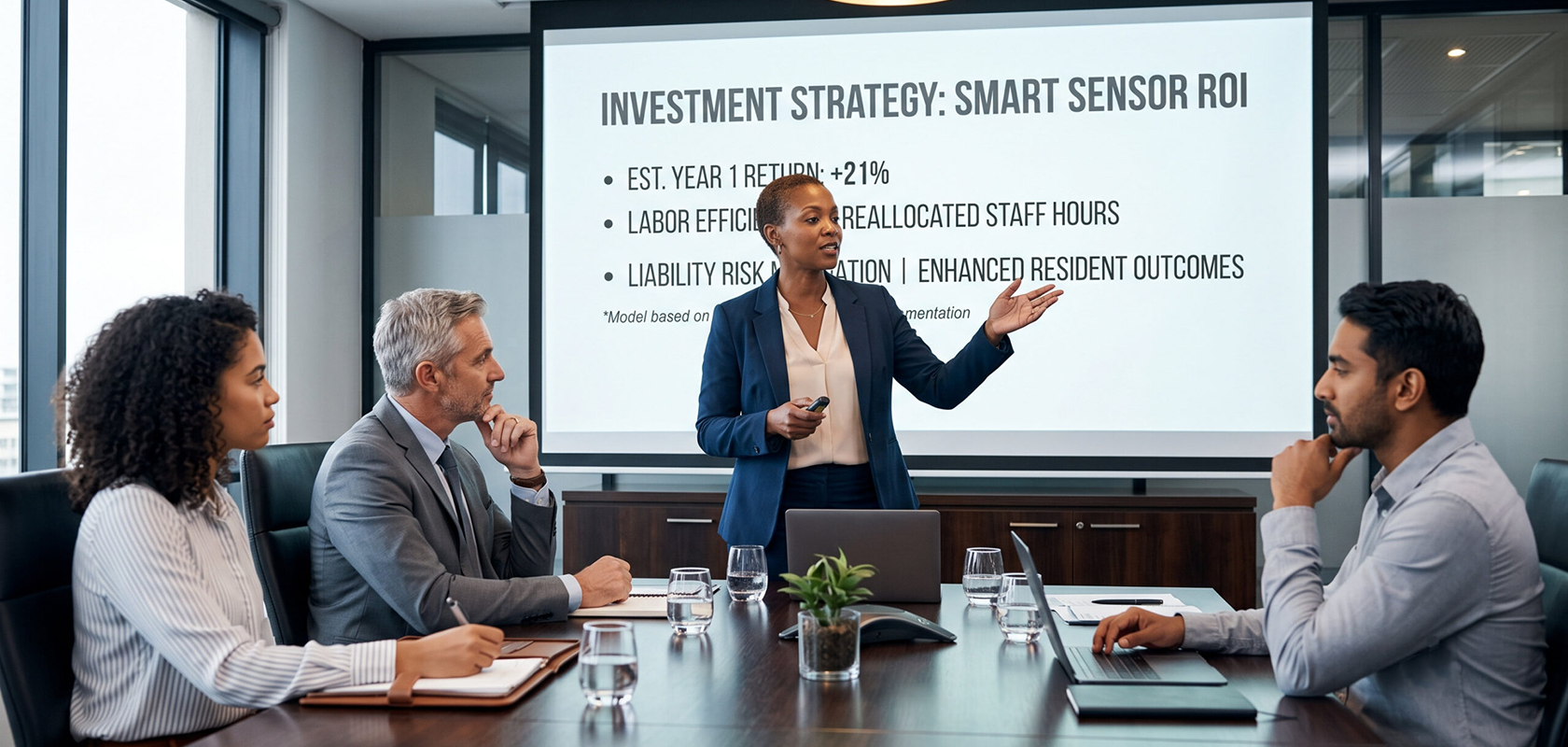
For facility operators, investing in technology is a business decision as much as a care decision. Ambient monitoring offers a compelling return on investment (ROI).
Increased Length of Stay
When residents and their families feel safe, they stay longer. By preventing falls and effectively managing chronic conditions using data insights, facilities can delay residents’ need to move to higher-acuity settings (such as skilled nursing or hospitals). Keeping residents healthy and independent in their current apartments directly impacts occupancy rates and revenue.
Operational Efficiency
Time is money. When staff aren’t spending hours on manual checks, they can be deployed more effectively. This efficiency can reduce overtime costs and allow facilities to operate smoothly even during staffing crunches. Furthermore, marketing a facility as “tech-enabled” and “proactive” is a powerful differentiator in a competitive market, appealing to adult children who are researching care options for their parents.
Implementation: What to Look for in a System
Not all ambient systems are created equal. When evaluating ambient sensor systems for senior care, consider the following factors:
- Ease of Installation: Look for wireless systems that can be installed quickly to minimize disruption for residents.
- Integration: The platform should integrate with your existing nurse call systems and electronic health records (EHR).
- Scalability: Can the system start with basic motion tracking and expand to include additional sensors (such as continence or medication management) as needs change?
- User-Friendly Dashboard: The data is only as good as the interface. Caregivers need clear, intuitive dashboards that show at-a-glance status updates, not complex spreadsheets.
The Future of Senior Care is Ambient
The era of the clipboard is ending. As the senior living industry faces the dual pressures of an aging population and a shrinking workforce, technology serves as the bridge. Ambient care monitoring is not about replacing human care; it’s about elevating it. It empowers caregivers with the vision they need to be in the right place at the right time.
By adopting passive monitoring technology, senior living communities can promise families that their loved ones are safe, respected, and truly seen—even when no one is in the room.
Improve Your Care Team Efficiency with AMBA
Is your staff overwhelmed by manual checks? Are you looking for ways to improve resident safety without compromising dignity? AMBA’s innovative sensor technology offers a proven solution. Our system installs in minutes and provides integrated, real-time insights into sleep, activity, and mobility.
Don’t rely on outdated monitoring methods. Empower your team and protect your residents with the next generation of ambient care.
Contact AMBA today to book a demo and see how we can transform your care operations.